
Roleground
Roleground helps job seekers prepare for one specific role. Paste a job description and a company URL, and it builds a researched kit: a sourced company brief, question bank, flashcards and study plan.
- Role
- Solo Full-Stack Engineer
- Tools
- Next.js · TypeScript · Google Gemini
- Type
- AI Interview Prep Platform
- Year
- 2026
01 · Overview
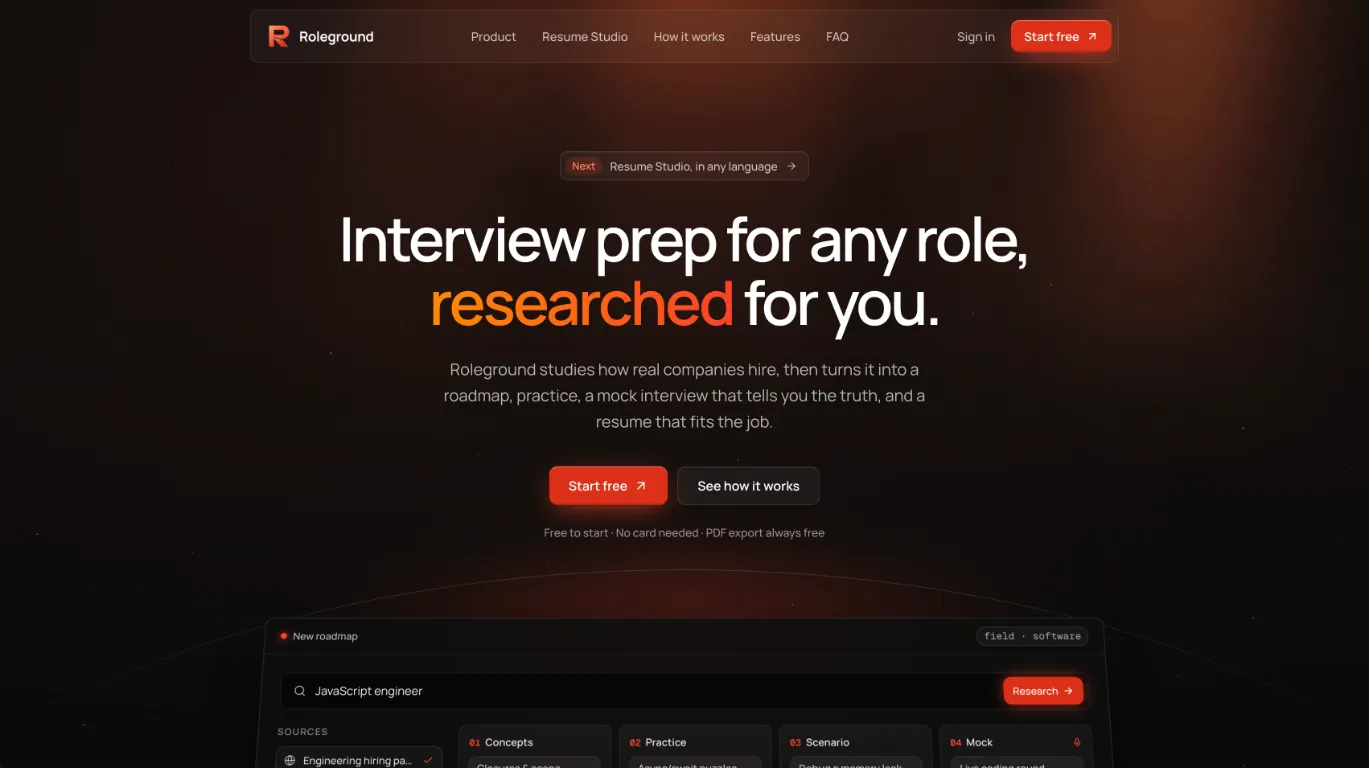
Interview prep researched for you
Originally built as Roleground; this was the project's initial product branding.
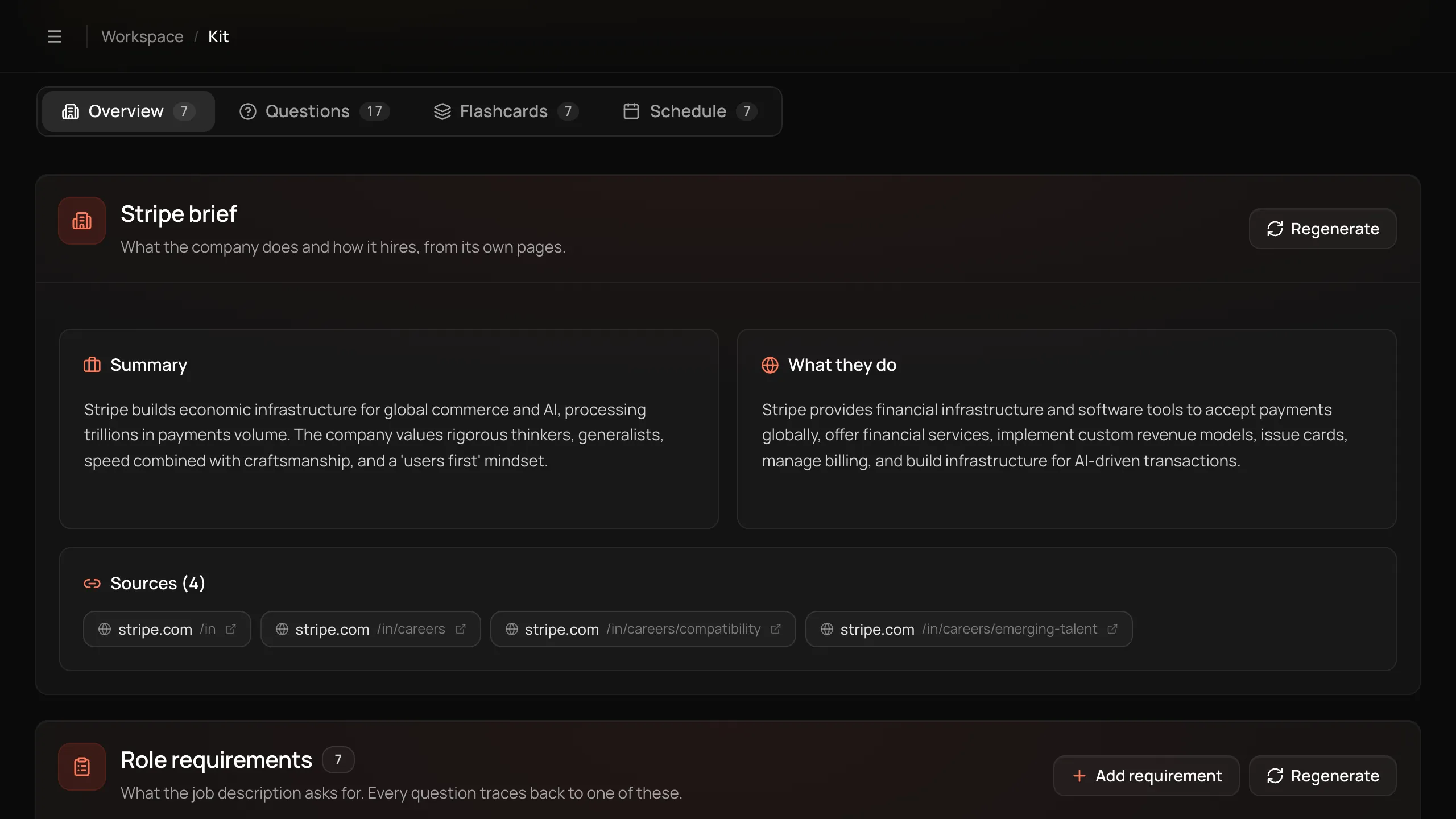
Roleground is a web app for people preparing for one specific job interview. I give it a job description, the company's website and the number of days I have. It reads the company's own pages, searches public discussion of how the company interviews, and builds a kit: a company brief with its sources, the role's requirements, a question bank in four tracks, flashcards and a day-by-day study plan.
I designed and built all of it on my own, from the database to the interface, and I'm growing it into a career prep platform one phase at a time. Two of eight phases are live today: the kit generator and a redesigned product site. Resume Studio is the phase I'm building now.
- Solo build
- Full stack
- Live on Vercel
02 · Problem statement
Generic prep misses the real job
Preparing for a specific interview usually means reading the job post, guessing which skills matter most, hunting through the company's careers pages, and stitching together questions from forums. It takes hours for every application, and most of that effort goes into gathering and sorting material rather than actually practising answers out loud.
Asking a chatbot for "interview questions for this role" is faster but hard to trust. It can invent requirements that are not in the posting, skip the ones that are, and give no sources for what it says about the company. I wanted a kit where every requirement is quoted from the posting, every must-have has at least one question, and the company brief lists the exact pages it was built from.
- Grounded output
- Source links
- Coverage
03 · Architecture
One monorepo, one deployment
The code is a TypeScript monorepo with npm workspaces. A core package holds all the pipeline logic behind small interfaces for the model, the web fetcher, search and storage, so nothing in it knows about Express or Next.js. The API is an Express 5 app, and the Next.js 16 app mounts it at /api/v1 on the same origin, so the sign-in cookie works without cross-site settings. A batch CLI runs the same pipeline from the command line.
MongoDB Atlas stores users, kits and run records through the native driver, with Zod 4 schemas as the single definition of a kit. Passwords are hashed with argon2 and sessions are signed JWTs in an httpOnly cookie. Model calls go to Google Gemini with Groq behind it, web search goes to Tavily with a keyless DuckDuckGo and Reddit fallback, and the whole thing deploys to Vercel as one project.
- Next.js 16
- Express 5
- MongoDB Atlas
04 · AI pipeline
Nine steps, checked in code
A run is an ordered list of nine steps sharing one state object: job text, crawled pages, search results, requirements, brief, questions and schedule. Five steps are critical and fail the run; the others record a skipped source with a reason and carry on. Retrieval is a live crawl of the company's own site: robots.txt, the sitemap and link scoring, then a gemini-3.5-flash-lite rerank that can only return indices into my list, so a page cannot inject a new URL.
Grounding happens in code. Each requirement must include a quote that appears word for word in the job description, or it is dropped. Question requirement ids that do not exist are removed. The company brief lists the URLs it used. Up to three gap-fill passes target uncovered must-haves, then a template question fills any that are left. Every call goes through one chain: Gemini with retries and backoff, one Groq failover when a key is set, and one repair attempt if the JSON fails its Zod schema.
- Gemini
- Groq
- Zod schemas
05 · Build
Finishing long runs on free tiers
The hardest problem was getting a run with around ten model calls, a site crawl and a web search to finish reliably inside a 240 second serverless budget, on free-tier models that rate limit and get retired without warning. Early on, configured Gemini and Groq model ids stopped working, and a failing provider could burn most of the budget on retries before anything else was tried.
I made the runner durable: it saves a run record to MongoDB after every step, so a run that hits the time limit comes back as partial and resumes from the first unfinished step, reusing finished output. Each provider has its own rate limiter. When Groq is configured, Gemini gets a single attempt before the call fails over, instead of up to 30 seconds of backoff per retry. The run page shows each step's real status and any skipped sources.
- Durable runner
- Failover
- Serverless budget
06 · Roadmap
From kits to a career platform
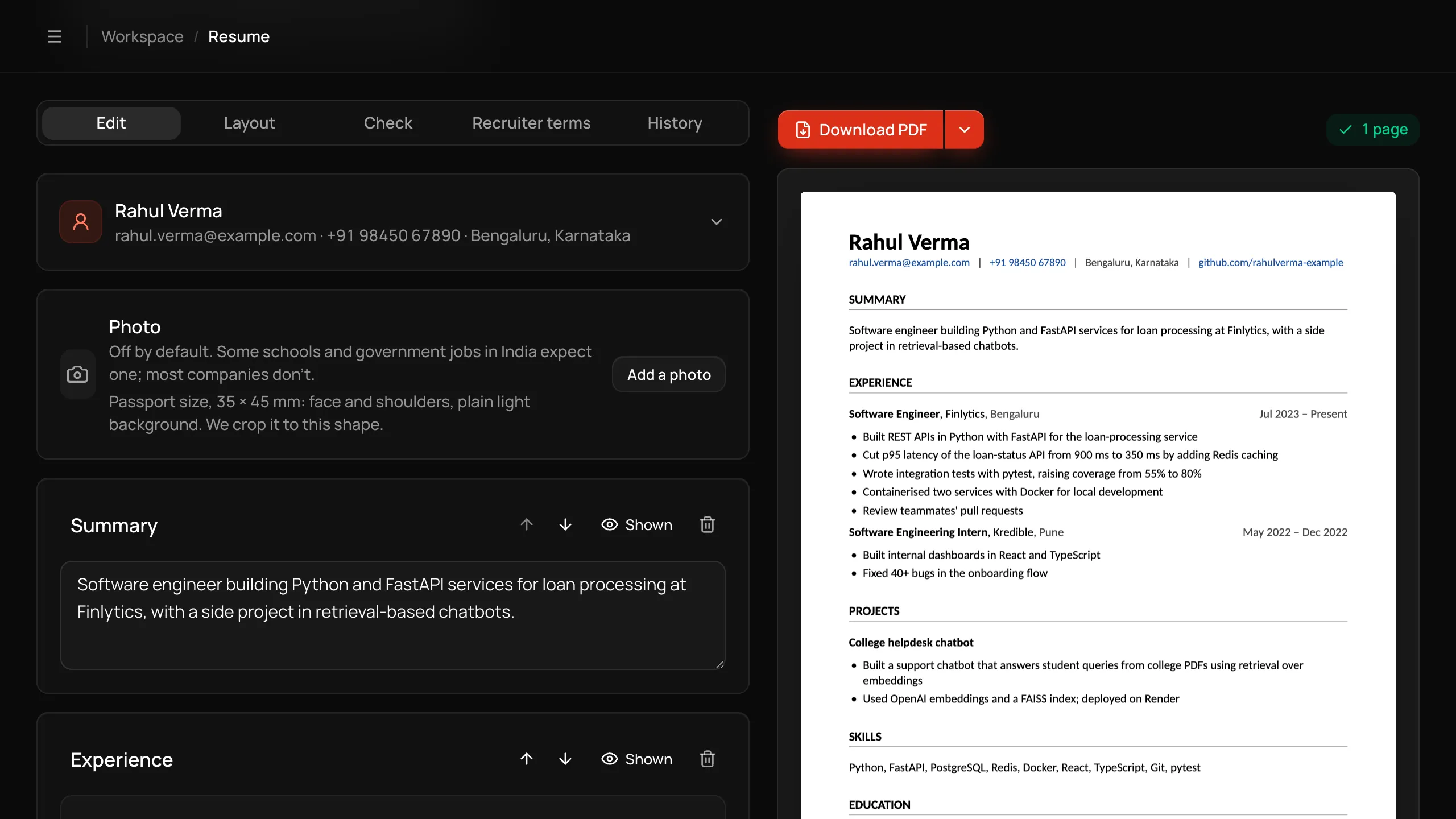
Two of eight phases are live. Resume Studio is in progress: its builder, editor, in-browser Typst PDF preview and Word and Markdown export run on demo data, but nothing is saved and no real model is called yet. The next part adds storage, model calls checked by a grounding rule, Gemini embeddings with Atlas vector search, and a LangGraph.js tailoring flow.
- 01Interview kit generatorResearch pipeline, editable kits with safe regeneration, practice mode and a batch CLI.shipped
- 02Landing page and workspaceA public landing page, sign-in at /login and a redesigned workspace.shipped
- 03Resume StudioBuilder, editor and PDF preview live on demo data. Saving and real AI come next.in progress
- 04Platform foundationPer-user daily limits, an optional personal Gemini key and delete-my-data.planned
- 05RoadmapsSkill and role roadmaps for any field, researched from public sources.planned
- 06Mock interviewsA voice interviewer on Gemini Live, with a report that quotes the transcript.planned
- 07Cross-pillar loopsA story bank from the resume, resume drills, and weak answers fed into roadmaps.planned
- 08Autofill extensionFills job application forms from the saved profile and never submits them.planned
07 · Project results
Live today
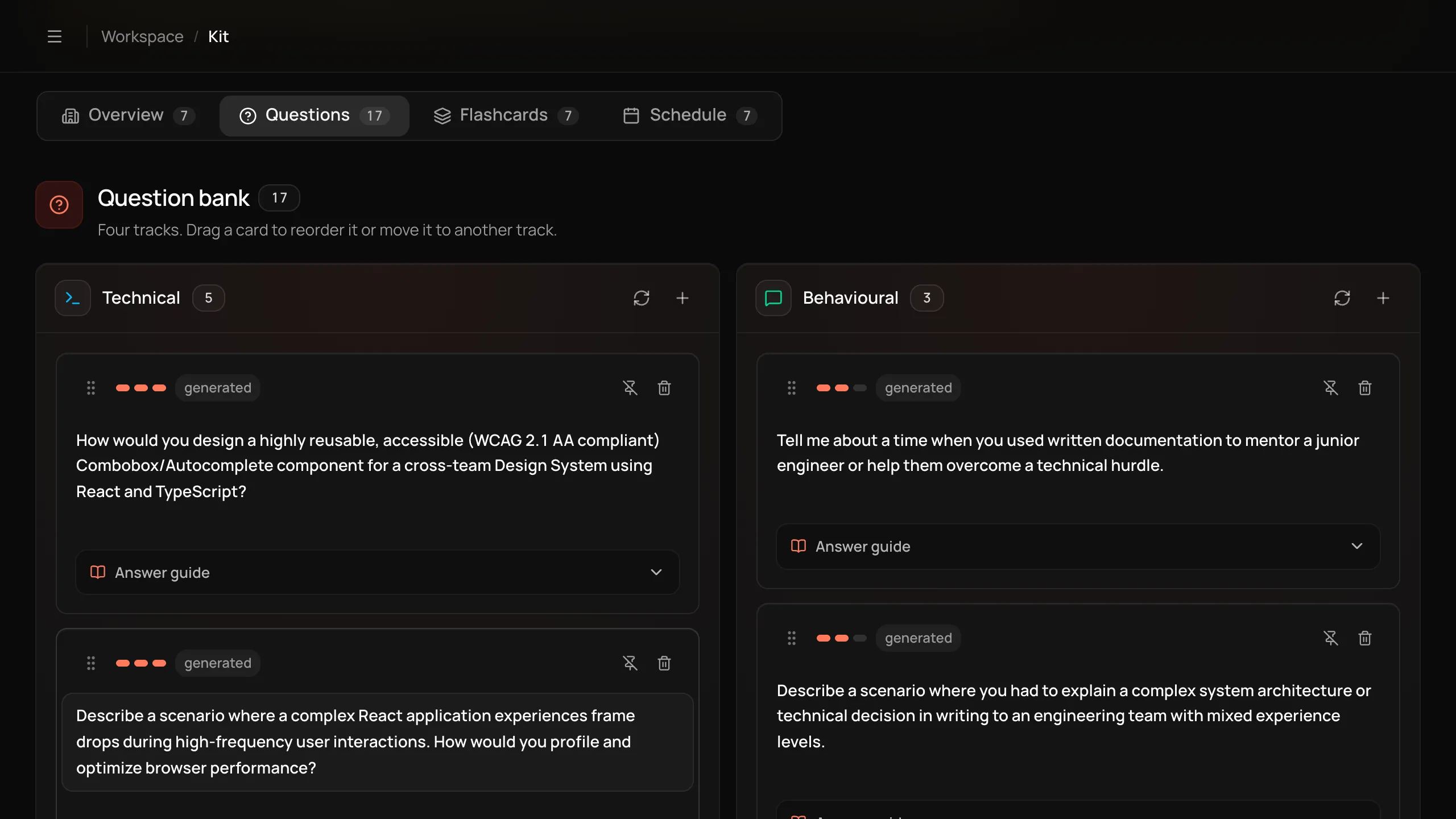
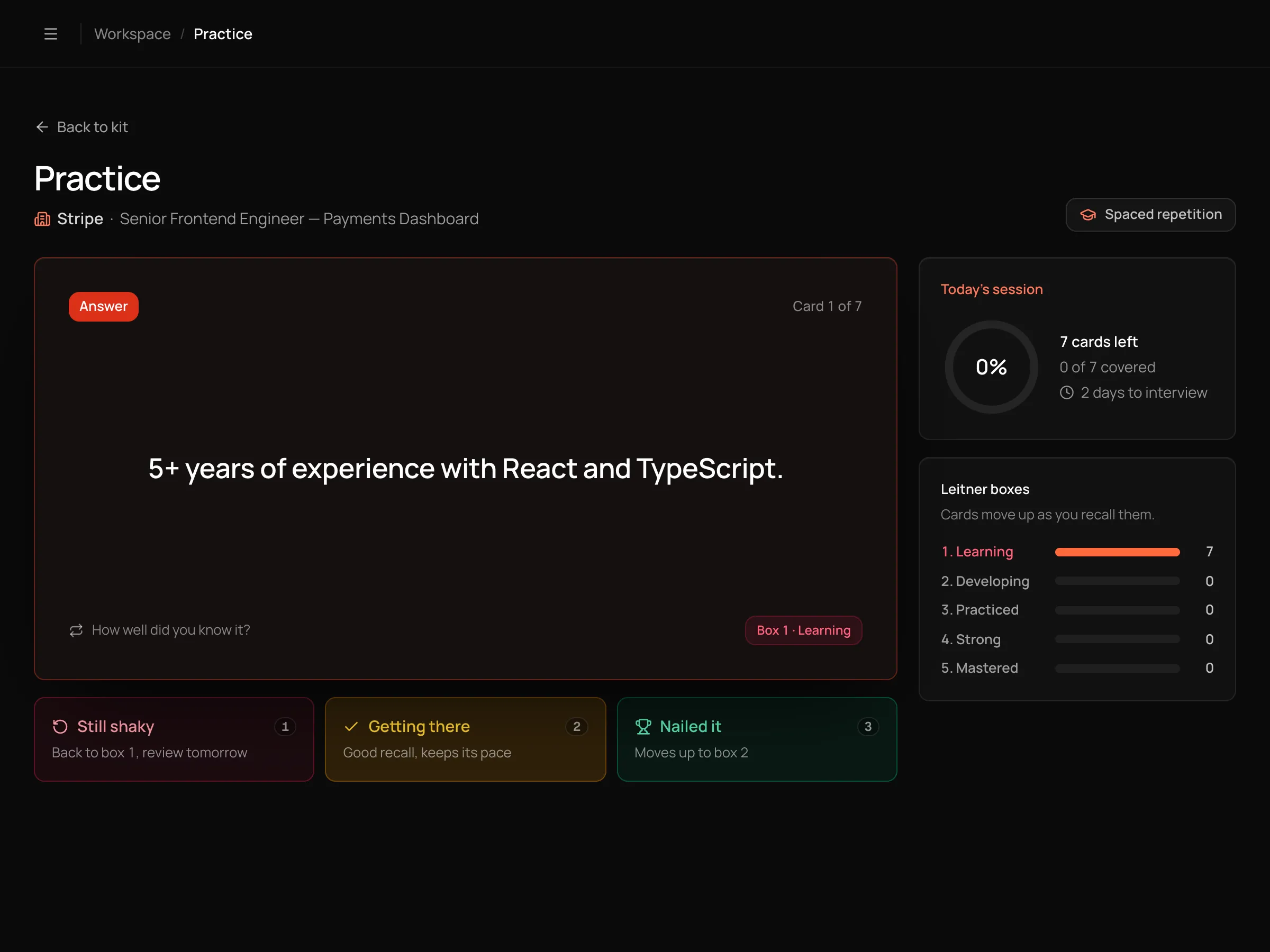
Roleground is live on Vercel. A signed-in user can generate a kit from a job description and a company URL, watch each pipeline step run, and get a sourced company brief, requirements marked must-have or nice-to-have, a question bank in four tracks with answer guides, flashcards and a study schedule. Kits can be edited, reordered and regenerated by section without losing hand edits or pinned items, and practice mode schedules flashcards with Leitner boxes up to the interview date.
- AI pipeline steps
- 9
- REST API endpoints
- 15
- Question tracks, one model call each
- 4
What shipped
- Built a nine-step research pipeline that crawls the company's site, searches public interview discussion and turns both into a kit.
- Designed a check that drops any extracted requirement whose quote does not appear word for word in the job description.
- Built a coverage loop that runs up to 3 targeted passes until every must-have requirement has a question, with a template fallback.
- Built a step runner that saves progress after every step, so a run cut off by the 240 second limit resumes where it stopped.
- Routed every model call through one chain: Gemini first, Groq as fallback, schema-checked JSON with one repair attempt.
- Built practice mode with five Leitner boxes that never schedules a card after the interview date.